











September 22, 2026
Do Wedding Bands Have to Match Engagement Rings? The Honest Answer
Dvik Jewels | bridal ring pairing | curved wedding band | do wedding bands have to match | Do Wedding Bands Have to Match Engagement Rings? The Honest Answer | lab grown diamond wedding band | mixing metals wedding rings | wedding band engagement ring pairing | wedding band matching engagement ring
Share
No, wedding bands do not have to match engagement rings. The old rule that both rings must share the same metal, finish, and style has faded, and in 2026, mixing metals, contrasting textures, and pairing rings from entirely different design families has become the dominant trend. What matters is that the two rings look intentional together, not that they be identical.
Getting there takes a little thought. There are a few practical decisions, including setting height, band profile, and metal karat, that quietly determine whether a pairing works or looks accidental. Get those right and you can put almost any two rings on the same finger and have them read as a set.
What does “matching” actually mean for bridal rings?
Most couples picture matching as same metal, same finish, same design family. That’s one definition, but it’s the narrowest one. A broader and more useful definition is visual coherence: the two rings share at least one design element that ties them together, even if everything else is different.
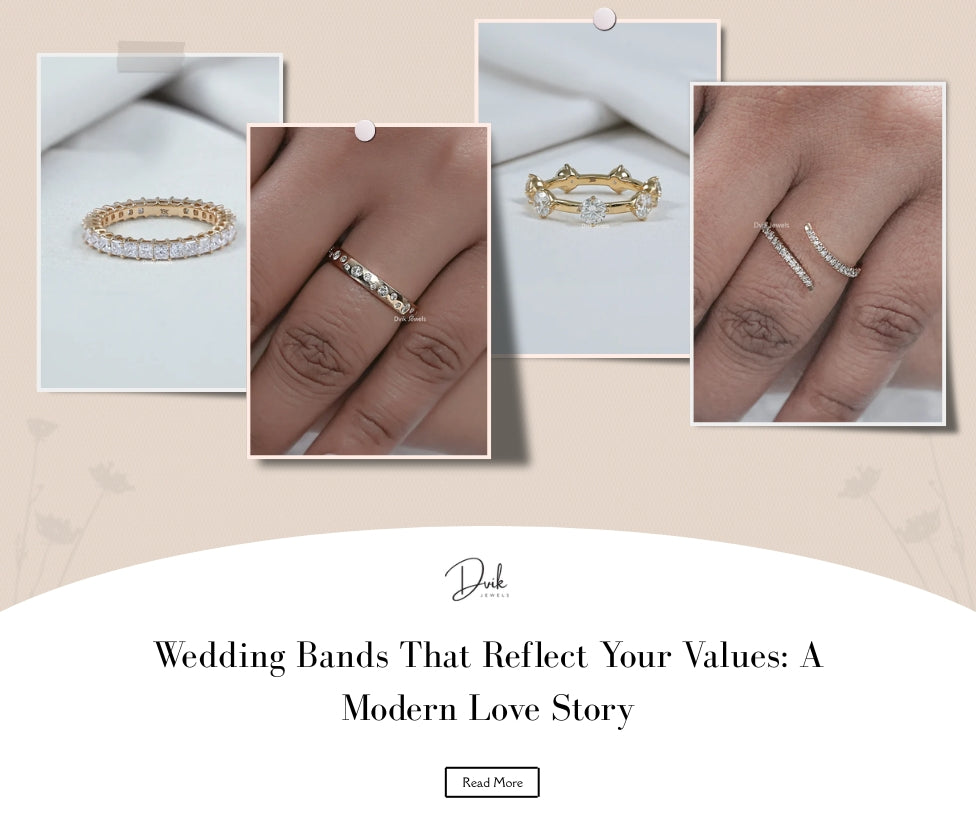
That shared element could be metal color, stone shape, band width, or even just a finish (both polished, both matte). A yellow gold solitaire paired with a slim yellow gold pavé band is a classic match. But a yellow gold solitaire paired with a rose gold eternity band also works, because rose and yellow gold sit in the same warm tonal family and enhance each other rather than compete. A platinum solitaire next to a yellow gold band creates deliberate contrast, and that contrast tends to look editorial and considered rather than confused.
The one thing that does matter: pick a single dominant metal and let it anchor the stack. Two rings with even one intentional link, whether shared metal color, finish, or width, almost always read as a pair; without that, the pairing can look accidental.
Why do some couples still choose coordinated sets?
Coordinated sets, where the engagement ring and wedding band are designed to nest together, solve a real physical problem, not just an aesthetic one. Many modern engagement ring settings, particularly halos, low-set bezels, and rings with decorative galleries, create a visible gap when paired with a straight band. A band designed to curve around the engagement ring’s profile eliminates that gap and produces a cleaner silhouette.
There’s also a practical comfort argument. When two rings sit flush, they move as one piece on the finger. A gap between them means the rings shift independently, which some wearers find irritating over a full day of wear.
For couples who buy both rings at the same time, a coordinated approach is often the path of least resistance. None of that makes it the only right answer, but the practical payoffs, fit certainty, visual consistency, and clean photos, explain why coordinated sets remain popular even as style rules have loosened.
Is mixing metals and styles actually mainstream now?
Industry coverage across bridal jewelry in 2026 consistently identifies mixed-metal stacks, contrasting textures, and intentionally mismatched silhouettes as among the most requested looks. Couples are increasingly choosing bands that “flow with their other jewelry” rather than rings that exist in isolation as a bridal set.
When it comes to mixing metals, keep the karat weight consistent even if you change the color. Pairing 14k yellow gold with 14k white gold is fine. Pairing 14k yellow gold with 18k white gold is trickier, because the two alloys age and scratch at slightly different rates, and over years of daily wear you may notice a visible tone gap between them.
Beyond that, the main principle is contrast versus harmony. Warm tones (yellow gold, rose gold) create a layered, cohesive look when paired together. Warm and cool tones (yellow gold next to platinum or white gold) create visual separation that lets each ring stand on its own. Both approaches work. The choice depends on whether you want the two rings to blend or to each make a statement.
What is the one factor that actually decides fit?
Setting height. It’s the variable most people overlook and the one that causes the most frustration after the fact.
High-set engagement rings, including classic cathedral solitaire and elevated four- or six prong setting, typically have enough clearance beneath the center stone for a straight band to sit flush. Low-set rings, along with halo settings, wide decorative galleries, and bezel-set stones, often prevent a straight band from sitting fully flush against the shank. The result is a gap that can look unintentional even if the style pairing is otherwise perfect.
The fix is usually a curved or contoured band: a band shaped to follow the outline of the engagement ring’s setting rather than running straight across the finger. This is the most common solution for halo settings and low-set stones, and it works regardless of whether the two rings match in any other way. A Round Lab Diamond Curved Wedding Band in a different metal from the engagement ring still solves the gap problem while mixing styles freely.
If you are buying both rings at the same time, it is worth flagging the setting height question before you commit to a band profile. If you already have your engagement ring, measure the clearance under the stone before ordering a straight band.
Your Band, Your Call
The fit rule is the only one that holds up. If the two rings sit comfortably on the finger without pinching, rotating, or leaving a gap that bothers you, the pairing works. Style, metal color, and design family are personal choices, and in 2026 there is no combination that a jeweler or anyone else can tell you is wrong.
Once fit is solved, the rest is taste. Dvik Jewels’ Wedding Band collection covers a range of profiles and price points, so whether you want something that coordinates closely with your engagement ring or something that reads as its own piece, there is a starting point without a large spend required.
FAQs
1. Can I wear a white gold wedding band with a yellow gold engagement ring?
Pairing white gold with yellow gold is a deliberate contrast that many jewelers and stylists consider one of the cleaner mixed-metal combinations. The key is keeping both rings at the same karat weight, such as 14k and 14k, so they age at the same rate and maintain consistent tone over years of daily wear.
2. Does a curved wedding band have to be from the same brand as my engagement ring?
A curved band from any brand will work as long as the curve depth and width are proportional to your engagement ring’s setting height and shank width. The most important measurement is the clearance under your center stone. If you are ordering online, measure that gap in millimeters before selecting a band profile.
3. Is it cheaper to buy a wedding band separately from the engagement ring?
Often yes. Bridal sets sold together sometimes carry a premium for the coordinated design. Buying a wedding band separately, particularly a lab grown diamond band, frequently gives you more options at a lower price point. Lab grown diamond half eternity bands can start around $196, which is well below the typical retail price for mined diamond equivalents of comparable quality.
4. What band width looks best next to a wide engagement ring shank?
A band that is within about 0.5mm to 1mm of the engagement ring shank width tends to look most balanced. Going significantly narrower makes the wedding band disappear visually. Going significantly wider can make the engagement ring look narrow by comparison. When in doubt, match widths closely and let the stone do the work of differentiating the two rings.
5. Do lab grown diamond wedding bands hold their value the same way mined diamond bands do?
Lab grown diamonds have lower resale value than mined diamonds, but the purchase price is also substantially lower, often 50 to 70 percent less for comparable carat weight and quality. For most couples, the relevant question is wearability and certified quality rather than resale, and IGI- or GIA certified lab grown diamonds carry the same grading standards as their mined counterparts.